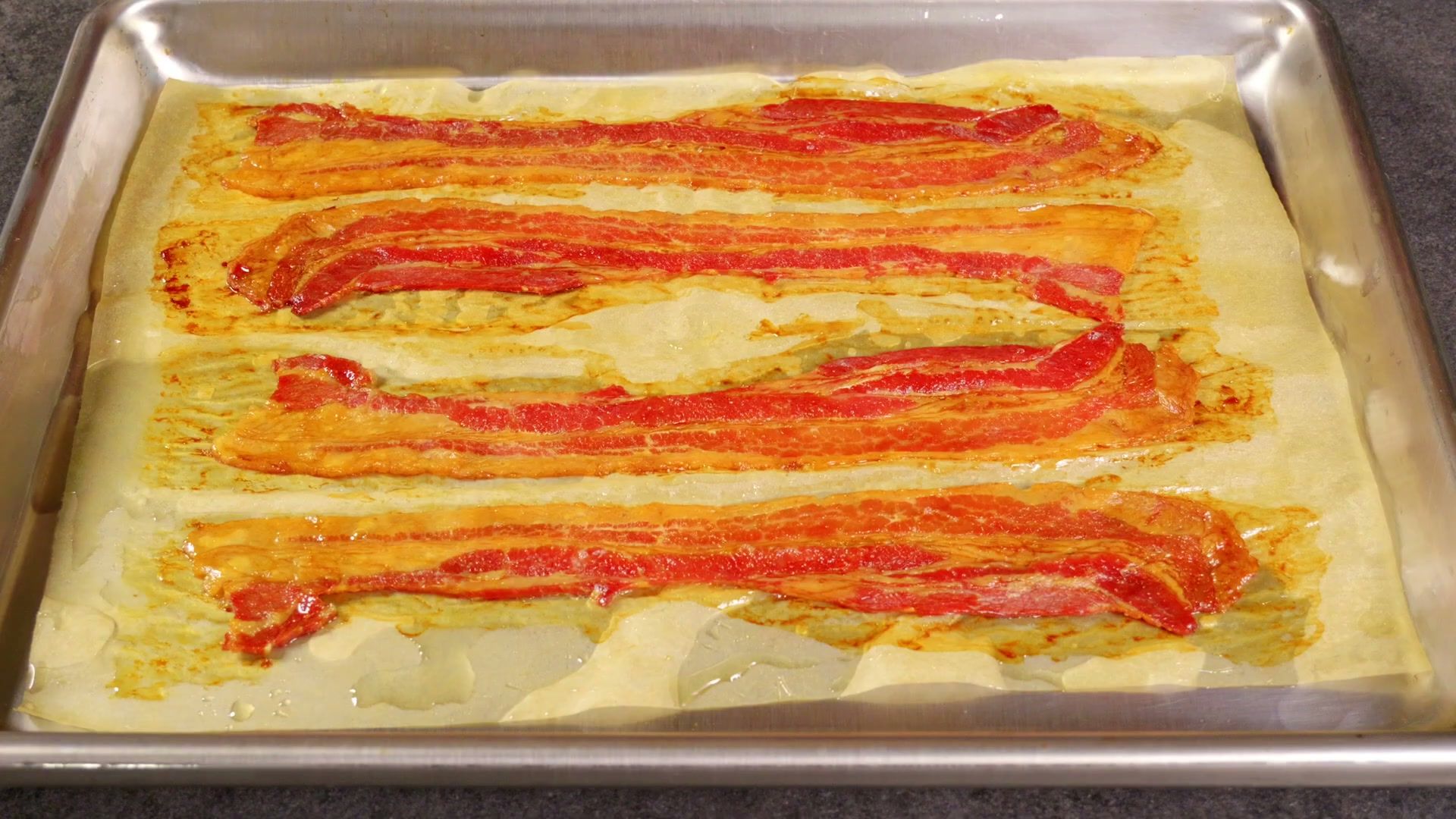
Restaurant kitchens never fry bacon loose in a pan, because fat shrinks faster than meat and every strip curls. The fix is two trays: line a baking tray with half a sheet of parchment, lay the strips out without touching, smooth the second half of the parchment over them, then add a second tray and weigh it down — a kettlebell, a brick, or a plain pot of water. Fifteen to twenty minutes at 200 °C and the whole strip crisps flat and even instead of twisting dry. The fat left in the tray is a second prize: washed in a jar of water and chilled lid-down, it sets into clean white fat you can fry anything in. Serves 2.
Instructions
- 1
Fold a long sheet of parchment in half, split it along the crease, and line a baking tray with one half. Keep the other.
- 2
Lay the bacon strips on the parchment, none of them touching.
- 3
Cover with the second half of parchment, smoothing it onto every strip, then set the second tray on top.
- 4
Weigh the top tray down — a kettlebell, a brick, or a pot of water all work. The weight is the whole trick.
- 5
Bake at 200 °C / 400 °F for 15–20 minutes. Lift the weight carefully, it comes out hot.
20:00 - 6
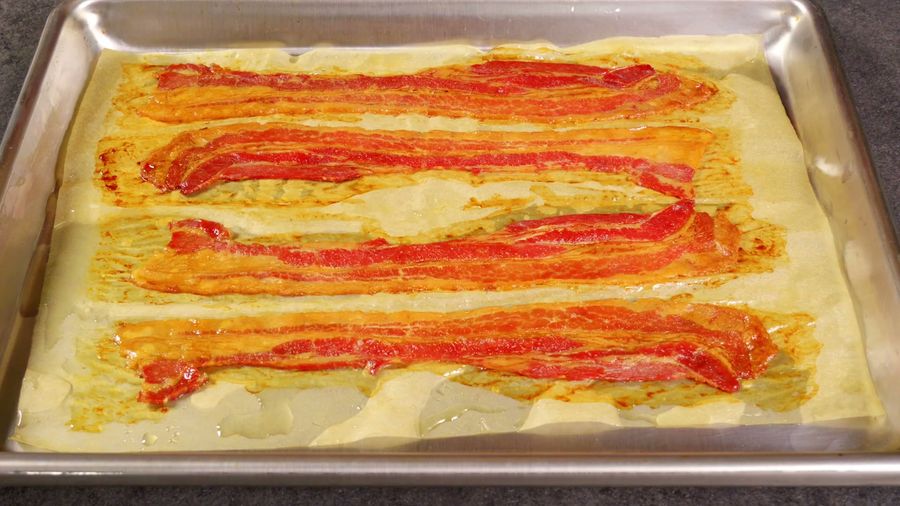
Peel back the top parchment: flat strips, crisped evenly end to end. Save the fat left in the tray.
- 7
To wash that fat, pour all of it into a jar, brown bits and everything, and fill almost to the rim with clean water.
- 8
Lid on tight, shake, then chill the jar lid-down until the fat sets solid.
- 9
Open the jar: with the lid underneath, the separated water sits on top and pours straight off, leaving clean white fat to reuse.
Watch the video
Notes from our kitchen
The weight is not optional pressure — it is what keeps the strip in contact with the parchment while the fat renders, so the whole length crisps at the same rate instead of buckling. Smooth the top sheet onto every strip; air pockets under it are where curling starts. And chill the fat jar lid-down deliberately: the water separates below the fat, so flipping the jar upright afterwards puts it on top, where it pours off in one go.
Variations
- Without a second tray. Any flat, oven-safe weight does the job — a heavy skillet, or a wire rack with a foil-wrapped brick on it. What matters is even pressure across all the strips; a weight that only covers half the tray gives you half flat bacon.
- What to do with the clean fat. It melts smoothly without the burnt bits, so it fries anything — the video finishes with an egg that picks up the savory bacon flavor for free. Roast potatoes and cornbread are the other classic homes for it.
Frequently Asked Questions
Why does bacon curl in a pan?
Because fat and meat shrink at different speeds — the fat contracts faster than the muscle, so each strip pulls itself into a twist. Nothing you do with the flame fixes it. Pressing the strips flat between two trays holds them in place until they have crisped, which is why restaurant kitchens cook bacon this way.
Do I need a special press or weight?
No — the video offers a kettlebell, a brick and a plain pot of water, and all three work. Anything oven-safe that spreads its weight over the whole top tray is fine. The pressure only has to be steady, not heavy.
Why wash the bacon fat with water?
The water pulls out salt and the burnt crumbs that would otherwise scorch when you reuse the fat. After chilling, the fat sets into a solid disc and the water separates out underneath — chill the jar lid-down, so when you turn it upright the water is on top and pours away, leaving clean white fat.
How do I store the bacon and the fat?
Cooked strips keep airtight in the fridge for 3–4 days and re-crisp in a hot oven in a couple of minutes. The washed fat keeps refrigerated in its jar — treat it like any rendered fat and use it within a few weeks, discarding it if it smells anything but clean and bacony.
Related Recipes
Bacon Pancakes

Cheesy Bacon Fresh Roll
Steakhouse Herb Butter

Creamy Cheese & Onion Dip
Coffee-Marinated Steak with Reverse Sear